Definition
Algorithm efficiency connects the mathematical world of asymptotic analysis with the real-world performance observed on actual hardware.
While asymptotic notation (O, Θ, Ω) describes growth rates, true efficiency depends on constants, data access patterns, cache locality, and implementation choices.
Note
Two Θ(n log n) algorithms may perform drastically differently in practice — asymptotic bounds only tell part of the story.
Why it matters
Efficient algorithms scale to larger inputs, reduce resource usage, and deliver predictable performance under diverse workloads and environments. Understanding efficiency guides choices among multiple correct algorithms by revealing how costs evolve as n grows, how constants and memory behavior influence real timings, and which trade-offs (time vs space, preprocessing vs query time) are sensible for a given system.
Why asymptotics matter in practice
We compare how work scales with n, not just a single machine’s runtime. This separates design quality from hardware or implementation quirks.
Model & Assumptions
Be explicit about your cost model
- RAM model with unit-cost integer arithmetic is standard for intro analysis.
- For large integers, hashing, I/O, or cache effects, annotate what counts as O(1) vs variable.
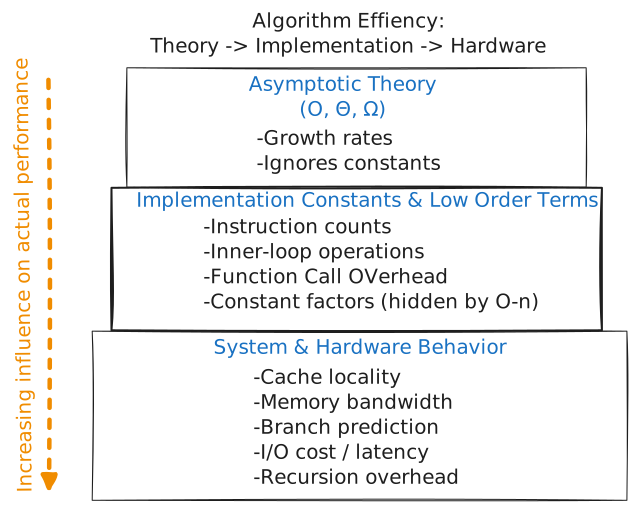
1. Asymptotic Growth
Describes how runtime grows with input size n:
- Ignores machine-dependent constants.
- Dominant for large
n, when high-order terms matter. - Provides comparative scalability, not timing.
2. Constant Factors & Low-Order Terms
Two O(n) algorithms can differ by a factor of 10× due to constant work per iteration.
Example:
T₁(n) = 10n
T₂(n) = 0.5n
Both O(n), but T₂ runs 20× faster.
Optimizing constants involves:
- Loop unrolling or inlining.
- Reducing redundant operations.
- Eliminating function call overhead.
3. Hardware & System Realities
Even optimal algorithms can underperform if they:
- Thrash the cache (poor locality).
- Perform random memory access.
- Cause branch mispredictions.
- Overuse dynamic allocation or recursion depth.
Tip
In modern CPUs, memory access pattern often dominates instruction count for large data sets.
Examples
Measuring Efficiency in Practice
Empirical testing complements theoretical analysis.
We run the algorithm on multiple input sizes and measure execution time, memory, and other metrics.
for n in [1000, 2000, 4000, 8000]:
    start = time()
    algorithm(data(n))
    print(f"n={n}, time={time() - start}")
Plot runtime vs. n to confirm theoretical growth.
Profiling
Profilers (like gprof, perf, or Python’s cProfile) identify hotspots — functions consuming the most time or memory.
Note
Efficiency ≠ speed. Sometimes slower operations (e.g., precomputation, caching) improve overall efficiency for repeated runs.
Input Sensitivity & Data Distribution
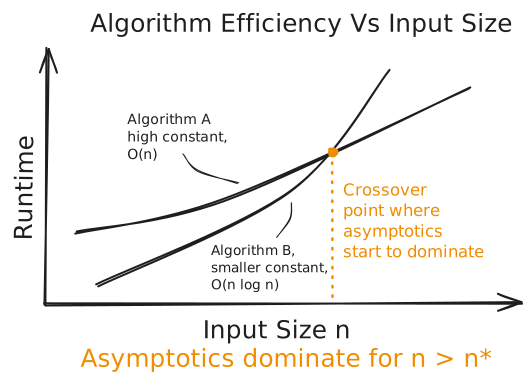
Theoretical complexity assumes worst-case or average-case over all inputs, but real inputs may favor one algorithm.
Examples:
-
QuickSort: worst-case O(n²), average O(n log n), but input ordering heavily impacts runtime.
-
Hashing: expected O(1), but collisions can make it O(n).
Tip
Benchmark on realistic workloads, not just random data.
Space Efficiency
Runtime isn’t everything — some algorithms trade speed for memory.
| Algorithm | Time | Space | Trade-off |
|---|---|---|---|
| Merge Sort | O(n log n) | O(n) | Simpler recursion, more memory |
| Heap Sort | O(n log n) | O(1) | Slower constant, less memory |
| Counting Sort | O(n + k) | O(k) | Fast for small key ranges |
Choose based on context: memory-constrained systems (embedded) may prioritize O(1) space.
Cache Behavior and Locality
-
Spatial locality: consecutive data access (arrays, matrices).
-
Temporal locality: reusing recently accessed data.
-
Pointer-heavy structures (linked lists, trees) often perform worse than array-based equivalents, despite identical asymptotics.
Tip
On modern CPUs, cache misses can cost hundreds of cycles — a Θ(n) algorithm with poor locality can lose to a Θ(n log n) algorithm with sequential access.
Practical Optimization Patterns
-
Data layout: use contiguous arrays instead of pointer chains.
-
Branch prediction: minimize unpredictable branches.
-
Loop fusion: merge loops to reduce passes over data.
-
Preallocation: avoid frequent reallocations.
-
Parallelization: leverage multicore hardware with independent subproblems.
Choosing an Algorithm
-
Match problem size: Small inputs → prefer simpler algorithms with low constants. Large inputs → asymptotic growth dominates.
-
Match environment: Memory-bound vs compute-bound; sequential vs parallel; real-time vs batch.
-
Match data properties: Sorted, random, or adversarial distributions; repetitive or unique key frequencies.
Example: Sorting Trade-offs
| Algorithm | Time | Space | Stability | Practical Use |
|---|---|---|---|---|
| QuickSort | O(n log n) avg | O(log n) | No | General-purpose |
| MergeSort | O(n log n) | O(n) | Yes | External sorting |
| HeapSort | O(n log n) | O(1) | No | Memory-limited systems |
| InsertionSort | O(n²) | O(1) | Yes | Small datasets |
Tip
Hybrid algorithms (e.g., Timsort) combine multiple strategies to balance constants and asymptotic growth.
Tiny growth-curve sanity check
Suppose n = 1..128. It’s common to see O(n log n) beat O(n) for small n due to constants. As n grows, the asymptotic term dominates.
Pitfalls
Common traps
“Average case” ≠ “expected value” unless the distributional assumptions match reality.
Amortized analysis averages across operations on a structure, not across input instances.
Big-O is an upper bound, not an identity; Θ gives tight bounds when known.
Ignoring cache/memory locality can invalidate “real” performance expectations.